

When Erin McDonald realized how much restriction and rigidity around food was holding her back, not just in sport but in her life, something shifted.
“I’d rather suck at running and get my life back,” she said, during on conversation for Lane 9 Podcast episode 71, as she reflected on the experience of leaving sport. At the time, her world had been shattered by the last race of her NCAA career. She was a standout athlete for Michigan State University Cross Country and Track, primed and favored to make Nationals. Then, her shoe fell off during the race.
“My shoe fell off when I was supposed to have the race of my life,” said McDonald, and it shook something loose in her. She realized what so many of us have experienced as well: You can do everything “right”, and still, you cannot control the outcome.
You can go to bed at 8pm every night, skip the parties or social outings, check the box for every workout, lift all the weights, eat the healthy things, carb load for days, and still…your shoe could fall off!
The day could be 85 degrees and humid! It could be pouring rain and windy…like it was when she won the 2025 Detroit Free Press International Half-marathon (in 1:16:04) last weekend. The outcome is not guaranteed, no matter what.
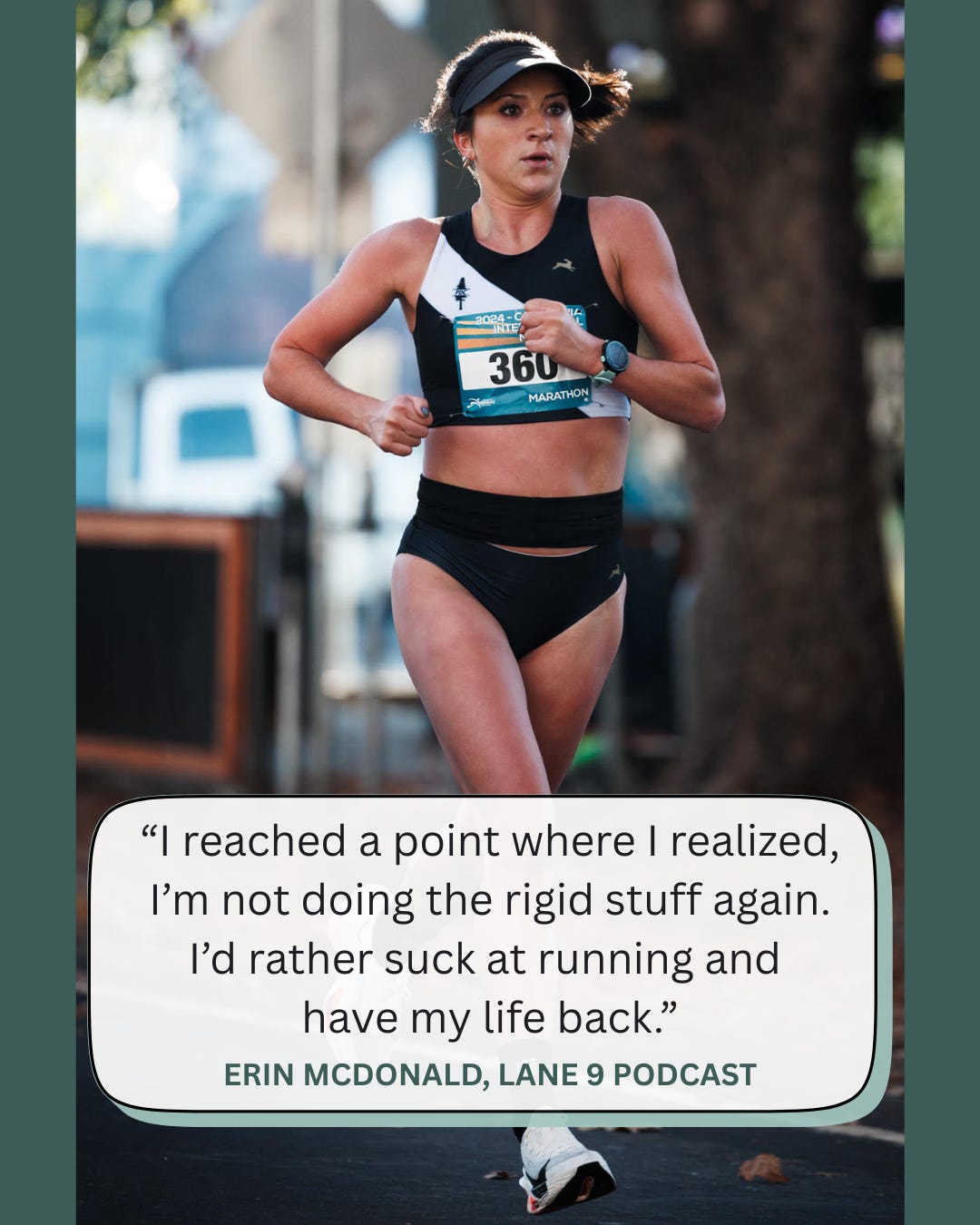
She ended up taking fours years away from running. As you’ll hear on the episode, that time was spent eating more flexibly, gaining weight, finding a good therapist and psychiatrist, and running very occasionally, with no structure and no goal in mind.
For four years, sometimes knowingly and sometimes unknowingly, she did The Work. As a clinician, I know she dug in, because to say “I’d rather suck at running and have my life back” is to set a boundary. It is to ask: What do I value more than my wellbeing and enjoyment of life? Nothing. That comes first, everything else is next. Even running. (Even when, in this case, she objectively does not suck at running!)
The timeline is important here, and she’s aware of that, too. “ I think that was what was really lucky, is I was able to separate [performance from weight gain]…so much time had passed where it’s like, I can’t blame it on the weight.” The it being a lack of fitness as she got back into training.
She notes that she did briefly try eating more during her freshman year of college, after meeting with the MSU sports dietitian. “ I thought, I’ll just gain a little weight and then go back to how I was. That just made me feel like crap.” It was unguided and unsupported, and she wanted it ‘work’ right away.
It wasn’t until she gave herself real time and space from the sport, mental health support, and a willingness to let the sport go if that’s what it took to be healthy and have her life back, to actually feel better.
The boundary she set was a turning point, and it highlights so much of what we talk about here in Lane 9. Some may be more familiar with the “ALL IN” mindset of hypothalamic amenorrhea or REDs recovery, same thing.
The roadblocks are similar for many athletes: fear of weight gain, fear of losing fitness, fear of it feeling hard, and coming back as a different athlete entirely.
All of those fears are real, normal, and so common.
The turning point is when an athlete realizes they have to decide what they value, and why. Erin McDonald found her life outside of sport, and she really enjoyed it. She felt more energized, balanced, and excited about new things—her job, her new city, reveling in the things she never did while she was rigid with her training. Then, she got curious about what it could like to welcome running back in, in a new way.
She was willing to suck at running, if it meant still having a life, letting go of the rigidity and discipline she once brought to her training. Could she be flexible with her training?
A few episodes ago, Stephanie Reents noted “…it seems like there’s almost like an inherent contradiction though between being disciplined and being flexible.”
When we think about athletics, and in this case running, “so much of training is about being disciplined,” Reents said, “and that discipline doesn’t leave much room for flexibility or so it seems.”
So it seems.
As someone who works with athletes, and wants to keep women in sport through all seasons of life, I think we can have both. The work is finding the ways that two are balanced for you, in your life, in your sport, without losing yourself in the process.
When McDonald came back to running, it was because she was curious about the marathon. But as she approached the training, she enlisted a friend to keep her accountable. If she started slipping back into old rigid habits and becoming overly-focused on the outcome, snap her out of it. The boundary was set again.
In this case, as we now know, she does not suck at running! She won a half-marathon last weekend, she set a new PR in the mile last summer (4:31), and her marathon PR is 2:36 from the 2024 California International Marathon. She’s been training with the Peninsula Distance Club for a little over a year. The workouts are hard, the training can get intense, but still, it doesn’t take over her life. And she’s the fastest she’s ever been.
But that was never the point for her, and that’s the most important part.
We cannot guarantee the outcomes, we cannot control whether you’ll be faster or “better” in the sport on the other side of REDs recovery, postpartum, after an injury, through any given season of life. If the goal is only (or secretly) to be faster or better, the sport is being placed above your wellbeing.
She wasn’t willing to go back to the restriction or rigidity, because in hindsight, she could see it may have only held her back. (We can also honor that for past versions of ourselves, those behaviors may have created some sense of safety, even if temporarily.) She was willing to try again, in a different way, to see if the joy could be reclaimed.
That’s what I love about seeing and sharing stories like Erin’s and many others we’ve shared on the podcast1: the opportunity and willingness to try it differently, and find a new way to keep or reclaim a sport we love. The ways that athletes in this community remind us what it looks like to stay curious, instead of rigid, and to let ourselves change as athletes in bodies that aren’t meant to stay the same.
Whether we “suck” at a thing or not, we can still have fun with it.
1 A few that come to mind right away from our podcast: Jess McClain, Cate Barrett, Jenny Grimshaw, Kassidy Johnson, etc.